

Imagine a financial record that no single person owns, no single organisation controls, and once recorded, is extraordinarily difficult to rewrite. That is the power of blockchain.
What Is Blockchain Technology?
Blockchain is a digital system for recording and sharing information in a way that is transparent, secure, and difficult to alter. In simple terms, it can be thought of as a shared digital record book in which transactions or other information are recorded and maintained across a network of computers.
Unlike a traditional database that is usually controlled by one organisation, a blockchain can distribute the same record across multiple participants in the network. When a new transaction is added, the network verifies it according to predefined rules. Once recorded, the information is linked to previous records, creating a chronological chain of data—hence the term “blockchain.”
How Does Blockchain Work?
A blockchain stores information in blocks. Each block generally contains a set of transactions or records, a timestamp, and a unique digital reference that connects it to the previous block. This creates a continuous chain.
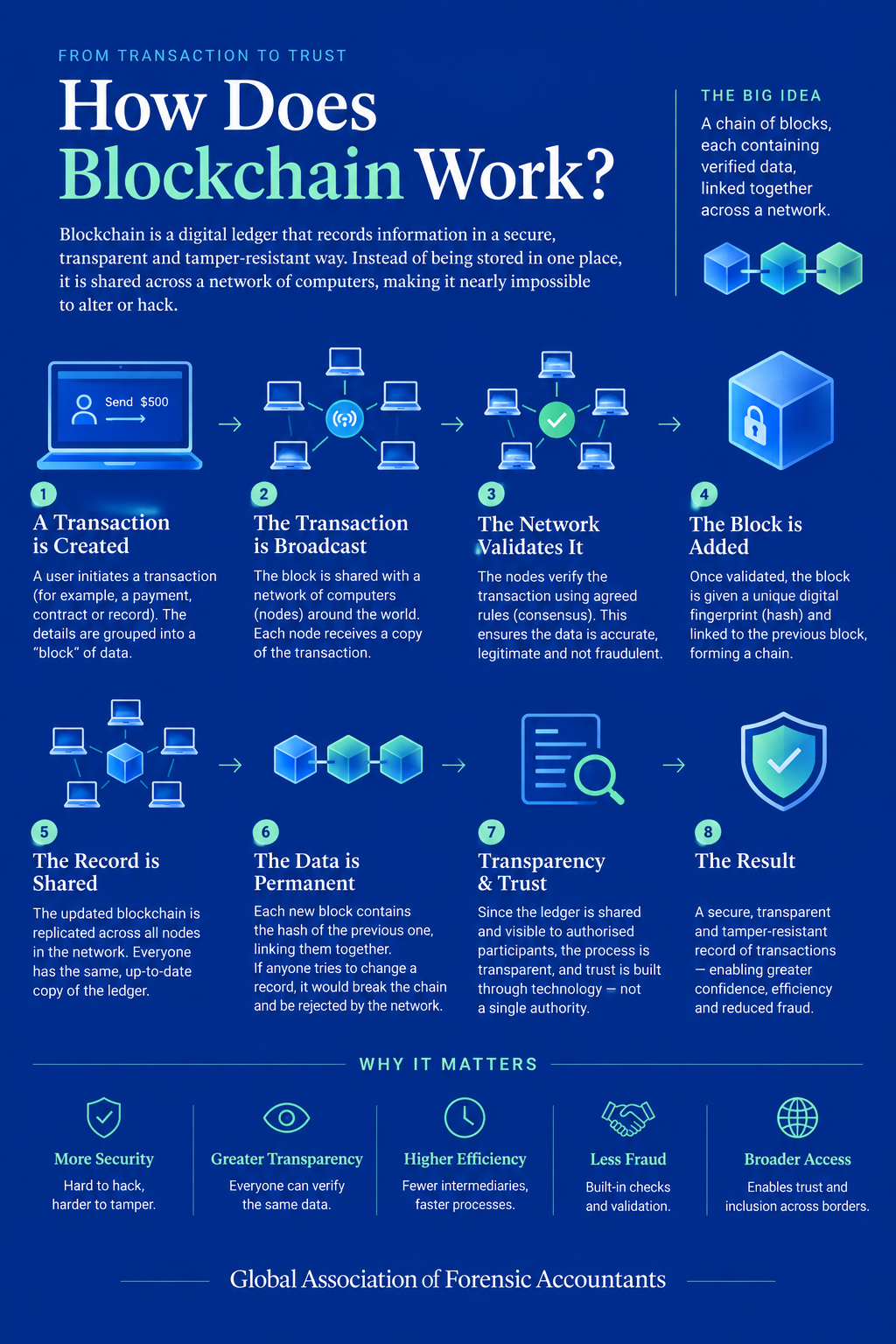
For example, imagine a digital payment being recorded on a blockchain. The transaction is first submitted to the network. The participating computers validate the transaction, after which it is added to a block. Once the block is accepted and added to the chain, the record becomes part of the shared history.
This structure makes unauthorised alteration considerably more difficult. Changing an earlier record would require the alteration to be reflected consistently across the connected records and, depending on the blockchain, accepted by the relevant network participants.
Why Is Blockchain Important?
Blockchain is best known for supporting cryptocurrencies such as Bitcoin, but its potential extends well beyond digital currencies. The technology can be used wherever organisations need reliable records, traceability, and controlled sharing of information.
Potential applications include financial transactions, supply-chain tracking, digital identity, smart contracts, asset ownership, insurance, and regulatory processes.
For investigators and financial professionals, blockchain is particularly important because transactions recorded on public blockchains can create a valuable source of digital evidence. Investigators can analyse transaction histories, trace the movement of digital assets, identify relationships between wallet addresses, and look for patterns that may indicate fraud, money laundering, sanctions evasion, or other financial crime.
However, blockchain should not be viewed as automatically “safe” or “fraud-proof.” The underlying record may be difficult to alter, but fraud can still occur through compromised wallets, fraudulent transactions, stolen credentials, deceptive schemes, or misuse of digital assets. Understanding the technology is therefore essential for interpreting blockchain-based evidence correctly.
Why Skill Enhancement Is Necessary
As financial crime increasingly moves into digital environments, professionals can no longer rely only on traditional investigation and audit techniques. Blockchain literacy is becoming a practical professional skill, particularly for accountants, auditors, investigators, compliance professionals, risk teams, and financial crime specialists.
The objective is not necessarily to become a blockchain developer. It is to understand how blockchain works, how transactions can be analysed, what evidence it can provide, and where its limitations lie. Building these skills enables professionals to investigate emerging forms of financial crime with greater confidence and relevance.
In a rapidly changing financial ecosystem, continuous skill enhancement is not simply an advantage—it is becoming part of professional preparedness.
Global Association of Forensic Accountants (GAFA)
Advancing Research and Professional Excellence

0 responses on "What is Blockchain?"